
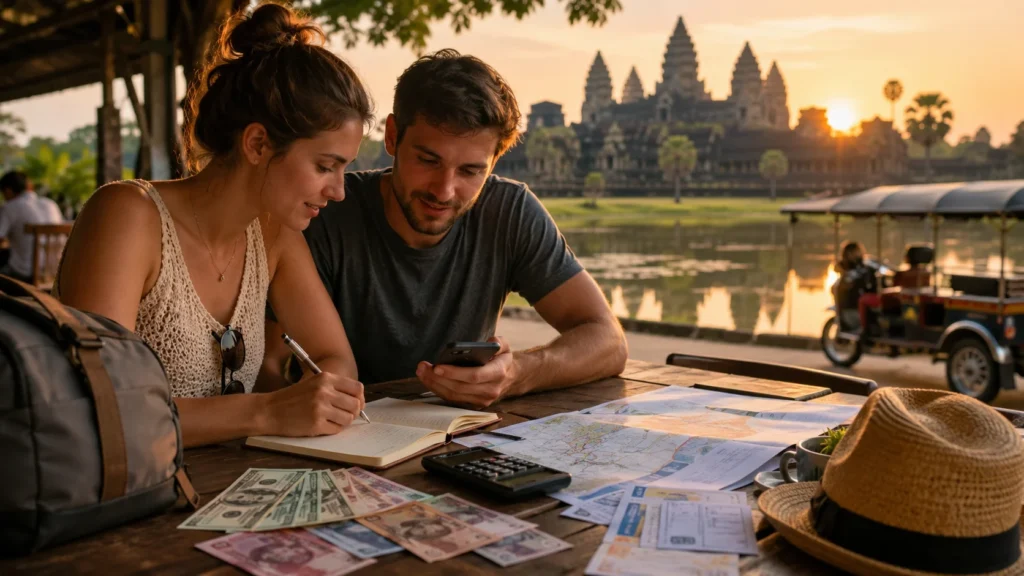
Picture this: a $2 bowl of noodles so good you order a second round, a guesthouse room with a hammock on the balcony for less than your morning coffee back home, and sunrise over Angkor Wat that costs the same whether you’re on a shoestring or splurging. That’s Cambodia‘s real magic — it bends to almost any budget without asking you to sacrifice the experience.
Why Cambodia Is Still One of Asia’s Best-Value Destinations
Even as tourism grows, Cambodia remains one of the most affordable countries in Southeast Asia, consistently priced below neighbors like Thailand and Vietnam for comparable comfort. You can genuinely eat well, sleep well, and see world-class ancient temples without needing a luxury budget — though if you do want to splurge, your dollar stretches remarkably far there too. The country runs on a dual-currency system, with US dollars used for anything over a dollar or so, and Cambodian riel handed back as small change, which makes budgeting refreshingly simple.
Daily Budget by Travel Style
Here’s the real range you’ll see, per person, per day (excluding international flights):
- Backpacker/shoestring: roughly $20-35/day — dorm beds, street food, public buses, and free or low-cost activities.
- Mid-range: roughly $40-70/day — private guesthouse or budget hotel rooms, a mix of local and Western meals, occasional taxis or tuk-tuks.
- Comfortable/luxury: $100-150+/day — boutique hotels or resorts, private drivers, guided tours, and higher-end dining.
Reality check: even the low end here buys a genuinely good trip, not a miserable one. Cambodia’s “budget” tier still includes air-conditioned dorms, real coffee, and enough left over for the odd splurge meal.
Accommodation: Where Your Money Goes Furthest
- Hostel dorm beds in Siem Reap, Phnom Penh, and Kampot typically run $5-12/night, with the well-known Mad Monkey chain and boutique-style options like Onederz both offering dorms from around $5-8.
- Private guesthouse rooms land around $12-25/night — the sweet spot for solo travelers or couples who want privacy without hotel prices.
- 3-4 star hotels run $35-70/night, and boutique hotels with a pool can be found for $50-80/night — remarkable value compared to similar quality elsewhere in the region.
- Five-star international chains (think Sofitel, Park Hyatt, Raffles) run $100-200+/night, still notably cheaper than equivalent luxury elsewhere in Asia.
- Money-saving tip: prices in guesthouses and hotels commonly drop 30-50% during the rainy season (roughly May-October), so shoulder-season travel is a legitimate budget hack, not just a weather trade-off.
Food: Cambodia’s Best Bargain
- Street food and local Khmer restaurants typically cost $1.50-3 per meal — think fresh spring rolls, noodle soups, and grilled skewers from a street stall or local market.
- Casual sit-down restaurants aimed at travelers run $4-8 per meal.
- Western food and higher-end restaurants in tourist hubs like Siem Reap’s Pub Street area or Phnom Penh’s riverside can run $10-20+.
- Our advice: eat where the locals eat as often as you can — it’s cheaper, usually tastier, and half the fun of traveling in Cambodia in the first place.
Getting Around: Transport Costs
- Tuk-tuks are the classic way to get around cities and temple complexes, running roughly $15-20 for a full day covering the Angkor temple circuit.
- City taxis in Phnom Penh are typically metered, starting around $0.75-1 plus $0.30-0.50 per kilometer — though some drivers prefer to negotiate a flat rate instead.
- Long-distance buses between major cities (Siem Reap to Phnom Penh, for example) cost $5-12 depending on comfort level, with operators like Giant Ibis and Mekong Express offering reliable VIP options.
- Domestic flights (Phnom Penh-Siem Reap, roughly 45 minutes) run $60-90 one-way, worth it if you’re short on time.
Attractions and Must-Do Experiences
- Angkor Pass: a 1-day pass is $37, a 3-day pass is $62 (usable across any 3 days within a 10-day window), and a 7-day pass is $72 — the 3-day pass is the best value for most first-time visitors.
- Tuol Sleng Genocide Museum and Choeung Ek Killing Fields: entry fees are modest, typically a few dollars each, for a profoundly important few hours.
- Floating village tours on Tonlé Sap: vary widely by operator, generally $15-35 depending on group size and inclusions.
- Island time on Koh Rong or Koh Rong Samloem: ferries run affordably, and bungalow accommodation ranges from budget-basic to genuinely upscale.
Insider Tip: Skip the Daily Ticket Trap
Buying a single-day Angkor Pass three separate times because you didn’t realize the multi-day options existed is one of the most common (and avoidable) ways travelers overspend in Cambodia. The 3-day pass costs only $25 more than a single 1-day pass but gives you three full days of temple access within a 10-day window — meaning you can pace yourself, skip a scorching midday session, and come back in better light. It’s the single easiest money-saving decision you’ll make on the whole trip.
Start Planning Your Cambodia Budget
Whatever your travel style, Cambodia has a way of delivering more experience per dollar than almost anywhere else in Southeast Asia — the trick is just knowing where your money goes furthest before you land. Use these numbers to build a realistic daily budget, then check out our full Cambodia entry requirements and 10-day itinerary guides to finish planning your trip. Bookmark this post, and share it with anyone still convinced Cambodia has to be either “backpacker cheap” or “luxury expensive” — it really doesn’t.