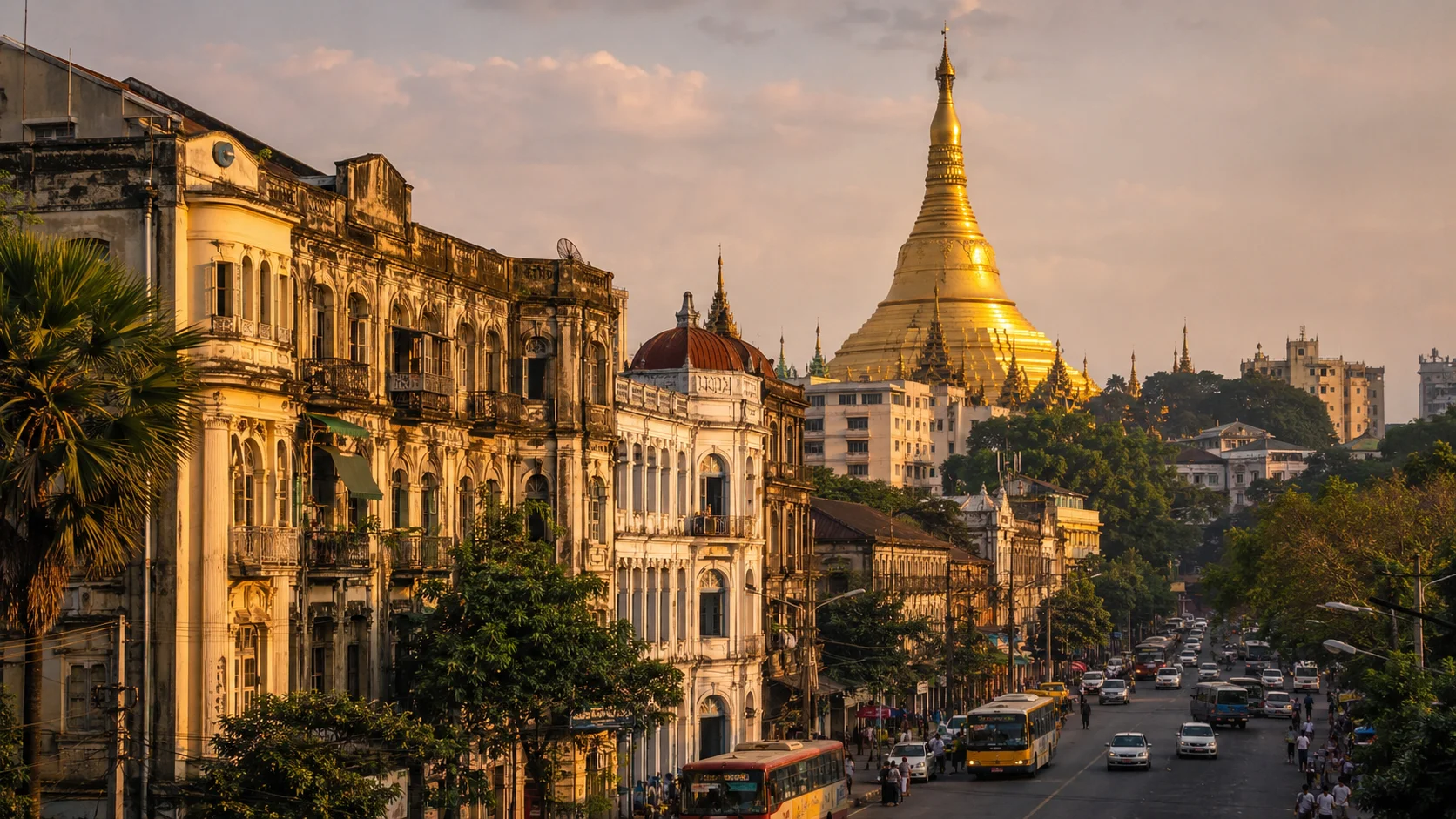
There’s a moment at Shwedagon Pagoda just after the sun drops below the Yangon skyline, when the gold-plated stupa seems to hold onto the last light longer than anything around it, and the marble terrace fills with families circling clockwise, laying flowers at their birthday-day planetary post, monks in maroon robes moving quietly between the smaller shrines. A few kilometers south, the same hour looks entirely different — colonial-era buildings along the Yangon River, their facades streaked with decades of monsoon damage and creeping vegetation, stand largely unrestored next to teashops where men argue about football over sweet, condensed-milk tea. Yangon holds one of the largest collections of colonial architecture in Southeast Asia, much of it decaying in place rather than converted into boutique hotels, alongside a religious devotion to Shwedagon that has continued uninterrupted for centuries. It’s also, as of this writing, a city operating under significant political strain, and any honest account of visiting has to start there rather than end there.
Shwedagon and Yangon’s Landmark Sites
Yangon’s most significant sights combine its Buddhist religious core with one of the region’s most intact — if weather-worn — collections of colonial-era buildings.
- Shwedagon Pagoda — A gold-covered stupa believed to enshrine relics of four Buddhas, the spiritual center of the city for over a thousand years and, for many Myanmar Buddhists, the most sacred site in the country.
- Sule Pagoda — A smaller, roughly 2,000-year-old stupa sitting at the literal center of downtown Yangon’s colonial-era street grid, functioning as both an active temple and a city landmark.
- Yangon Colonial Downtown — A dense grid of early 20th-century British administrative buildings, many unrestored, including the former Secretariat building and the old High Court, best explored on foot with attention to still-functioning teashops and bookstalls along the way.
- Chaukhtatgyi Buddha Temple — Home to a 65-meter reclining Buddha statue housed in a large open-sided hall, notable for the intricately painted soles of its feet depicting Buddhist cosmology.
- Bogyoke Aung San Market — A covered colonial-era market built in 1926, selling gems, traditional textiles, and handicrafts, and a useful stop for understanding Myanmar’s craft traditions in one place.
A full day covers Shwedagon and the downtown colonial core comfortably; visiting Shwedagon in the late afternoon and staying through sunset is worth prioritizing over a rushed midday visit.
Beyond Shwedagon: A City Finding Its Own Voice
Bogyoke Aung San Market and the surrounding downtown streets remain the city’s commercial anchor, with gem traders, tailors, and textile sellers operating much as they have for decades, offering a more grounded counterpoint to the pagoda’s spiritual focus.
Yangon’s teashop culture, concentrated throughout downtown and in neighborhoods like Chinatown (around Latha and Lanmadaw townships), functions as the city’s real social infrastructure — low plastic stools, sweet tea, and a rotating cast of regulars discussing everything from football to, quietly, politics.
For a cultural experience with depth, the Secretariat Building, the site of General Aung San’s 1947 assassination and now partially open for guided tours, offers a sober historical anchor for understanding modern Myanmar’s political trajectory, distinct from Shwedagon’s purely devotional focus.
Where to Eat in Yangon
Myanmar cuisine draws on Indian, Chinese, and Thai influences while remaining distinct from all three, built around fermented and pickled flavors less common elsewhere in the region.
Dishes to look for:
- Mohinga — a fish-based noodle soup often considered Myanmar’s national dish, eaten most commonly for breakfast from street stalls and teashops.
- Lahpet thoke (fermented tea leaf salad) — a distinctly Burmese dish combining fermented tea leaves with crunchy fried beans, nuts, and sesame, a flavor with few real equivalents elsewhere.
- Shan noodles — rice noodles from Myanmar’s Shan State, served either in a light broth or dry, tossed with a slightly spicy pork or chicken sauce.
- Ohn no khao swè — a coconut chicken noodle soup with clear South and Southeast Asian influences, comparable in spirit to Malaysian laksa or Thai khao soi.
Fine dining: Rangoon Tea House offers an elevated, design-forward take on traditional Burmese teashop food and dishes in a stylish downtown setting. Le Planteur serves French-influenced fine dining in a colonial-era villa setting, popular for special occasions.
Mid-range and social-enterprise spots: Shwe Sa Bwe trains disadvantaged youth in hospitality while serving a solid Burmese and international menu. Feel Myanmar Food is a long-running, well-regarded spot for a wide buffet-style spread of traditional Burmese curries and sides.
Street food and markets: Mohinga stalls scattered throughout downtown and near Bogyoke Aung San Market offer the dish at its most local and least expensive. The teashops around Chinatown double as informal street food spots come evening.
Coffee and cafes: Yangon has a growing specialty coffee scene alongside its traditional teashops — spots near the Sule Pagoda downtown area offer a quieter alternative to the teashop crowd for those wanting a workspace and a proper espresso.
Where to Stay in Yangon
Luxury: The Strand Yangon, a restored 1901 colonial-era hotel on the riverside, remains the benchmark historic luxury property in the city. Rosewood Yangon occupies the former Land Registry building, blending heritage architecture with a more contemporary luxury offering.
Boutique and mid-range: Several restored colonial-era buildings downtown have been converted into smaller boutique hotels offering character and a central location at a more moderate price point than the flagship luxury properties.
Budget: Guesthouses cluster around downtown Yangon near Sule Pagoda and Bogyoke Aung San Market, offering simple rooms within walking distance of the main sights.
Where to base yourself: Downtown Yangon, within walking distance of Sule Pagoda and the colonial core, offers the most practical base for sightseeing on foot, while staying closer to Shwedagon Pagoda suits travelers prioritizing sunset and early morning visits to the site.
What to Do Beyond Shwedagon
- Colonial architecture walking tour — A guided or self-directed walk through downtown Yangon’s early 20th-century buildings, best done with some background reading given how little on-site signage explains the buildings’ history.
- Circle Line train ride — A roughly three-hour commuter train loop around Yangon’s outskirts, offering a look at daily life and local markets well outside the main tourist areas.
- Bogyoke Aung San Market shopping — A stop for traditional textiles, gems, and lacquerware, useful for understanding Myanmar’s craft traditions before or instead of visiting other parts of the country.
- Chaukhtatgyi and Ngahtatgyi Buddha temples — A pairing of two significant Buddha statue temples within walking distance of each other, offering a quieter alternative to Shwedagon’s crowds.
- Kandawgyi Lake walk — A lakeside park near downtown offering a green, relatively quiet break from the city’s density, with a view back toward Shwedagon Pagoda across the water.
- Traditional teashop crawl — An informal but genuinely rewarding way to experience Yangon’s daily social rhythm, best done with a local guide or app-based recommendation given how many teashops exist without English signage.
- National Museum of Myanmar — Home to the country’s largest collection of historical artifacts, including royal regalia from the last Burmese monarchy, offering useful context before or after visiting Shwedagon.
When to Go: Yangon Travel Guide Seasons
- November to February — The cool, dry season and generally the most comfortable window for walking the city, with lower humidity than the rest of the year.
- March to May — Hot season, with temperatures climbing significantly and high humidity, generally the least comfortable window for extended walking.
- June to October — The wet season, with heavy monsoon rain common, particularly in July and August; short-notice flooding in low-lying downtown streets is possible during the heaviest weeks.
Practical Notes for the Trip
- Current safety situation: As of 2026, Myanmar remains under a Level 4 “Do Not Travel” advisory from the US State Department, with similar high-level advisories from the UK, Australia, Canada, and the EU, citing ongoing armed conflict, risk of arbitrary detention of foreign nationals, and unpredictable local conditions. Yangon itself has generally continued functioning with hotels, restaurants, and transport operating, and is considered comparatively calmer than conflict-affected border regions, but conditions can change quickly and vary by neighborhood and timing. Anyone considering this trip should check their own government’s current advisory immediately before booking, monitor local news closely in the lead-up to travel, and avoid all political gatherings, demonstrations, and even casual political conversation in public. Comprehensive travel insurance that explicitly covers travel to a Level 4 advisory country, including medical evacuation, is strongly advised rather than optional.
- Getting there: Yangon International Airport has a reduced but functioning set of regional connections; flight availability and routing have changed significantly since 2021 and should be reconfirmed close to departure.
- Getting around: Ride-hailing apps (Grab) operate in Yangon and are generally the most practical way to get around; carrying identification is advisable given the presence of military checkpoints in parts of the city.
- Visas: Tourist visas are required in advance through a Myanmar embassy or approved e-visa system; visa-on-arrival services have been suspended, and processing times can run considerably longer than in the past.
- Dress code and etiquette: Modest dress is required at Shwedagon and other pagodas, with shoes and socks removed before entering; photographing security personnel, checkpoints, or any protest activity should be avoided entirely.
- Currency: Myanmar operates largely as a cash economy given banking restrictions; bringing sufficient clean, undamaged US dollars for exchange is standard practice, as card acceptance remains limited outside a small number of hotels.
A Final Thought
Yangon holds two things at once that don’t resolve easily into a single takeaway: a genuinely moving religious and architectural history, and a present-day political reality that any visitor has an obligation to understand before booking a flight. The gold of Shwedagon at sunset is real, and so is the checkpoint a few streets over. Anyone weighing this trip should treat official government advisories as the starting point for that decision, not an afterthought to work around.