

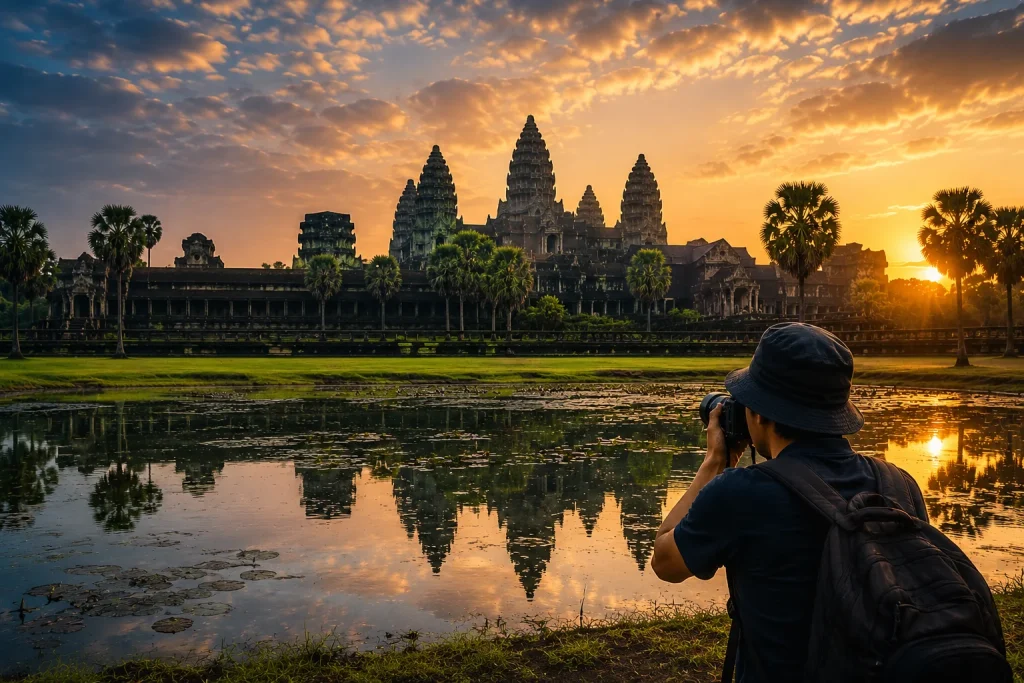
Angkor isn’t one temple — it’s an archaeological park roughly the size of a small city, and different corners of it photograph completely differently depending on the hour, the season, and how far you’re willing to walk from the parking lot. This guide covers where the light is actually worth chasing, and the practical details that make the difference between a decent photo and one worth printing.
Why Angkor Rewards Photographers Specifically
Most travel destinations have one or two iconic angles. Angkor has dozens, spread across temples built over several centuries in noticeably different styles — the geometric grandeur of Angkor Wat itself, the enormous carved faces of the Bayon, the tree roots swallowing Ta Prohm’s stone walls, and the pink sandstone carvings at Banteay Srei. A single sunrise-to-sunset day can move through more visual variety here than most countries offer in a week.
The Essential Shots
Angkor Wat at sunrise, from the reflecting pools — The classic shot, and it’s classic for a reason: the five towers silhouetted against a rising sun, mirrored in the water in front of the western entrance. Arrive at least 45 minutes before sunrise to claim a spot at the pool on the left side, which tends to be less crowded than the main causeway pond.
The Bayon’s carved faces, mid-morning — The Bayon’s 200-plus serene stone faces photograph best when side-lighting rakes across the carvings, which usually means mid-morning rather than midday. Look for the narrow galleries where a single face frames against the sky.
Ta Prohm’s tree roots, filtered light — Ta Prohm is intentionally left half-reclaimed by jungle, with silk-cotton tree roots wrapped through the stonework. Overcast conditions or dappled shade actually help here more than harsh sun, softening the contrast between root and stone.
Banteay Srei’s pink sandstone carvings, late afternoon — Smaller and further out than the main complex, Banteay Srei is known for the finest, most intricate carving of any Angkor-era temple. Late afternoon light warms the sandstone’s natural pink tone and brings out the depth of the relief work.
Preah Khan’s quiet corridors, any overcast day — Less visited than Angkor Wat or Ta Prohm, Preah Khan’s long, empty colonnades photograph well precisely because they’re usually empty of other visitors.
Timing: Light Matters More Than the Calendar
- Sunrise (5:00–6:30am): Best for Angkor Wat’s silhouette shot and for beating the crowds at every major temple.
- Mid-morning (7:00–10:00am): Good side-lighting for carved detail work at the Bayon and similar temples, before the midday sun flattens everything.
- Midday (11:00am–2:00pm): Generally the toughest window — harsh, flat light and the peak heat of the day. Worth using for temple interiors and shaded corridors instead.
- Late afternoon (3:30–5:30pm): Warm, angled light suits sandstone carvings and wide temple facades, particularly at Banteay Srei and Angkor Wat’s eastern side.
Season matters too: the November–February dry season gives the clearest skies and best visibility for sunrise shots, while the wet season (June–October) brings dramatic cloud formations and a genuinely green landscape, at the cost of predictability.
Practical Notes for Photographers
- Tripods are generally fine for personal photography but may require a permit for commercial shoots — check current rules with your guide before assuming.
- Drones are heavily restricted around Angkor and typically require advance permits arranged through the Apsara Authority; don’t assume you can fly on arrival.
- Modest dress is required at active temple sites, which affects how you move and shoot — plan clothing that covers shoulders and knees rather than fighting it on location.
- Crowds build fast after sunrise at Angkor Wat specifically; if the reflecting-pool shot is your priority, everything else can wait until later in the day.
- A wide lens and a longer lens both earn their place — wide for full temple facades and reflections, longer for isolating carved details and compressing the Bayon’s stacked faces.
A Suggested One-Day Photography Route
- Pre-dawn: Angkor Wat reflecting pools for sunrise.
- Mid-morning: The Bayon, for face carvings in raking light.
- Midday: Ta Prohm’s shaded, root-wrapped corridors, where the softer light works in your favor.
- Late afternoon: Banteay Srei, timed for warm light on the pink sandstone (note: it’s roughly 40 minutes outside the main complex, so budget travel time).
This is a full day, and a demanding one — most people don’t attempt to shoot all four locations properly in a single visit. Spreading it across two days gives each location the time it actually rewards.