
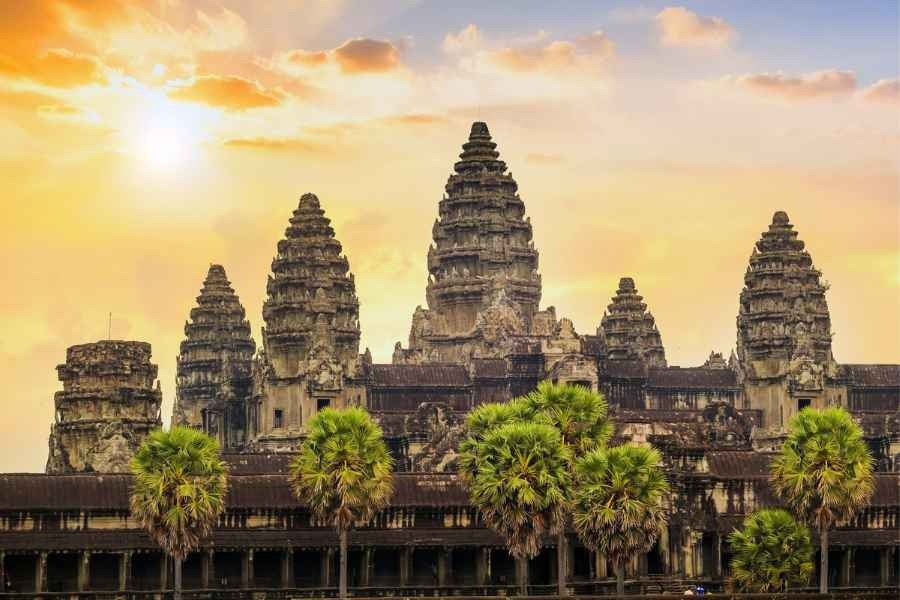
Cambodia is often visited for one reason — Angkor Wat — and left with several more. Beyond the temples, it’s floating villages on the Tonlé Sap, a countryside bamboo train outside Battambang, a capital still finding its footing after a difficult modern history, and a pace of life that’s noticeably slower than its neighbors. This guide covers what to actually plan for: when to go, where to spend your time, how much it costs, and the practical details that don’t show up in a highlight reel.
At a Glance
- Best time to visit: November to February (cool, dry season)
- Typical trip length: 4–7 days for Cambodia alone; longer if combined with Laos or Vietnam
- Currency: US Dollar (widely used); Cambodian Riel for small change
- Language: Khmer; English is common in Siem Reap, Phnom Penh, and tourist areas
- Visa: E-visa available online, or visa-on-arrival at major airports and land borders
- Getting around: Private drivers between cities, tuk-tuks for short local trips
When to Go in Cambodia
Cambodia has three broad seasons, and they matter more than people expect:
- November–February (cool, dry): The most comfortable window — lower humidity, little rain, and pleasant temperatures for full days at Angkor. This is also peak tourist season, so expect more visitors at major sites.
- March–May (hot, dry): Temperatures climb sharply, often into the high 30s°C (upper 90s°F). Still dry, but midday temple-hopping gets uncomfortable fast.
- June–October (wet): Rain arrives most days, usually in short, heavy bursts rather than all-day downpours. The countryside turns green and the Tonlé Sap swells, which is actually a good time to see the floating villages at their most dramatic — just plan around the rain.
If your dates are flexible, aim for November through February. If they’re not, each season has a version of Cambodia worth seeing — it just changes what you should prioritize.
Where to Go in Cambodia
Cambodia is compact enough to cover its highlights without feeling rushed.
Siem Reap & Angkor — The reason most people book the trip. Angkor Wat itself is one temple among hundreds in the wider archaeological park; the Bayon’s carved stone faces and Ta Prohm’s tree-swallowed ruins are just as worth the time. Siem Reap town has grown into a genuinely good small city around it, with a strong food and nightlife scene of its own.
Phnom Penh — The capital, and a different kind of visit. The riverside promenade and Royal Palace are the obvious stops, but the Tuol Sleng Genocide Museum and Choeung Ek (the Killing Fields) are the ones that stay with people — sobering, but an important part of understanding the country. Phnom Penh also has Cambodia’s best food scene.
Koh Rong & Koh Rong Samloem — Island time, usually saved for the end of a trip. Quiet beaches, warm water, and little to plan once you’re there — a deliberate contrast after several temple-heavy days.
Battambang — The slower, less-visited alternative to the main circuit. French colonial architecture, countryside scenery, and the bamboo train (a plank-on-wheels contraption that’s more fun than it sounds) draw travelers who want fewer crowds.
Kampot & Kep — Riverside pepper farms and a famous crab market, at a pace that’s slow even by Cambodian standards. A good closing stop before flying out or crossing into Vietnam.
A Sample 7-Day Route for Cambodia
- Days 1–3: Siem Reap & Angkor — Sunrise at Angkor Wat, the Bayon, and Ta Prohm, spread across three unhurried days rather than rushed into one.
- Day 4: Battambang — A scenic drive through the countryside, the bamboo train, and an evening in the old French quarter.
- Days 5–6: Phnom Penh — The Royal Palace, the riverside, and a proper introduction to Khmer food away from tourist menus.
- Day 7: Kampot, or onward — Extend south to Kampot for a slow finish, or connect into Vietnam or Laos if your trip continues.
This is a starting point rather than a fixed package — the order and pace should flex around your dates and how much downtime you actually want.
Getting Around
Cambodia doesn’t really have a self-drive culture for visitors, and most travelers don’t need one:
- Between cities: Private drivers or shared minivans cover the main routes (Siem Reap–Phnom Penh–Battambang) comfortably in a few hours each.
- Domestic flights: Worth considering if you’re short on time — Siem Reap to Phnom Penh is under an hour by air versus 5–6 hours by road.
- Within cities: Tuk-tuks are the standard short-hop option and are inexpensive; agree on a price before getting in, or book through your hotel or guide to avoid haggling.
Food
Khmer food doesn’t get the international attention Thai or Vietnamese food does, which is part of the appeal — it hasn’t been simplified for anyone. A few things worth seeking out:
- Amok — A mild, coconut-based curry, usually with fish, steamed in a banana leaf.
- Kuy teav — A breakfast noodle soup, often with pork and offal, sold from small stalls in the early morning.
- Bai sach chrouk — Grilled pork over rice, another classic breakfast dish.
- Kampot pepper crab — Worth the trip to Kep on its own; fresh crab stir-fried with the region’s famous green peppercorns.
Budget
Cambodia is inexpensive relative to many parts of Southeast Asia, though prices in Siem Reap have risen with tourism:
- Budget travelers: $25–40/day covering guesthouses, street food, and local transport
- Mid-range: $60–120/day covering comfortable hotels, private drivers, and sit-down restaurants
- Higher-end: $150+/day for boutique or luxury stays and fully arranged private touring
Angkor Archaeological Park tickets are a separate cost worth budgeting for: roughly $37 for one day, $62 for three days, or $72 for seven days (prices are periodically adjusted, so confirm current rates before booking).
Culture & Etiquette
- Dress modestly at temples — shoulders and knees covered, for both men and women.
- Remove shoes before entering homes and some temple buildings.
- The head is considered the most sacred part of the body; avoid touching anyone’s head, including children’s.
- Public displays of affection are uncommon and best kept low-key.
- A small, genuine effort with basic Khmer greetings (“suosdey” for hello) is well received.
Practical Tips
- Visa: Apply for the e-visa online a few days before travel to save time at the border; visa-on-arrival is also straightforward at major entry points but involves more queuing.
- Money: ATMs are widely available in cities and dispense US Dollars. Carry small bills — change is often given in a mix of USD and Riel.
- Health: Tap water isn’t safe to drink; bottled or filtered water is standard and cheap. Basic travel insurance is worth having, as is checking recommended vaccinations with a travel clinic before you go.
- Connectivity: Local SIM cards are inexpensive and easy to buy on arrival at the airport or in town.
- Angkor timing: Sunrise at Angkor Wat is popular for a reason, but the temple complex is large enough that visiting mid-morning or late afternoon at other temples avoids the biggest crowds.
Pairing Cambodia With Other Countries
Cambodia’s dry season overlaps closely with Laos, Thailand, and Myanmar, which makes any of those a natural addition to a longer trip without a seasonal conflict. Vietnam pairs well too, though its northern and southern halves run on slightly different weather patterns of their own — worth checking before combining a Cambodia–Vietnam route into a single itinerary.