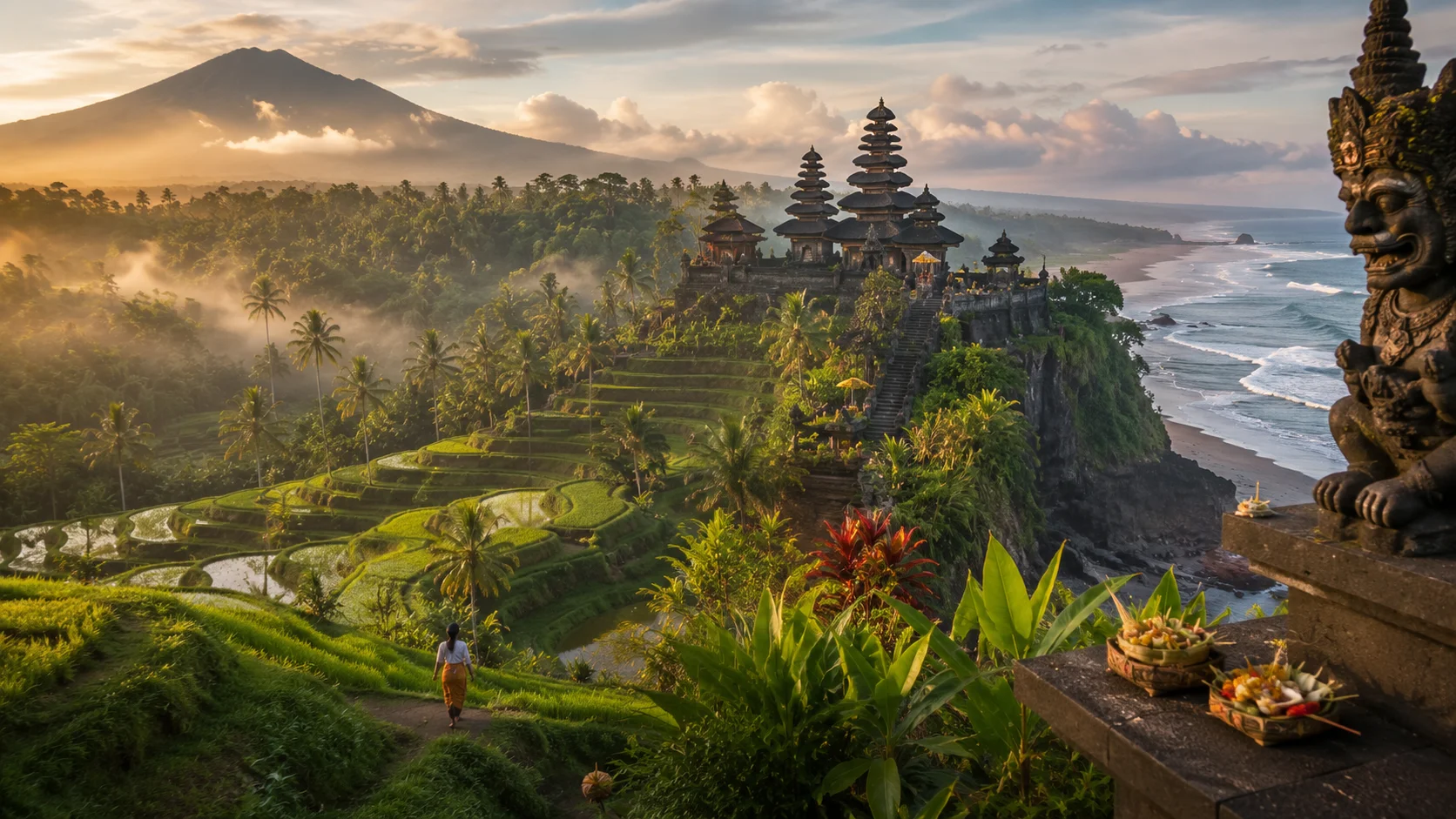
There’s a sound that follows you through Bali before you notice you’re listening for it — the metallic chime of gamelan practice drifting from a family compound, layered under the crash of surf on a black-sand beach and the low murmur of a priest’s chant at a roadside shrine. Incense smoke curls from a small woven offering left on a sidewalk, stepped around rather than stepped on, a daily ritual so constant it becomes part of the island’s texture rather than a performance for visitors. Bali carries a reputation as a honeymoon backdrop and a wellness-retreat cliché, and it’s easy to see why given how heavily it’s been photographed. But the island is large, geographically and culturally varied, and a single beach club or infinity pool barely scratches its surface. Most visitors give it a week; the island rewards those who pick two or three distinct regions rather than trying to see all of it in one trip.
Temples, Rice Terraces, and Bali’s Landmark Sites
Bali’s most iconic sights span the island’s interior and coastline, each tied closely to Balinese Hindu religious life rather than built purely for visitors.
- Tanah Lot — A sea temple perched on a rock formation just offshore, best visited at sunset when the silhouette against the water draws large crowds, though the temple itself is only accessible to worshippers during religious ceremonies.
- Tegallalang Rice Terraces — Cascading, hand-cultivated rice paddies near Ubud that follow the traditional subak irrigation system, a centuries-old cooperative water-management method recognized by UNESCO.
- Uluwatu Temple — A clifftop temple on Bali’s southern peninsula, home to a resident troop of macaques and a nightly kecak fire dance performance staged against the sunset.
- Besakih Temple — Bali’s largest and holiest temple complex, spread across the slopes of Mount Agung, made up of over twenty individual temples rather than a single structure.
- Mount Batur sunrise trek — A pre-dawn hike up an active volcano in Bali’s central highlands, rewarding climbers with a view over the caldera lake and, on clear mornings, as far as Mount Rinjani on neighboring Lombok.
A week is a reasonable minimum to cover two or three regions of the island properly; trying to base in one town and day-trip to everything else usually means long, traffic-heavy drives that eat into actual time at each site.
Beyond the Temples: Bali’s Towns Finding Their Own Voice
Ubud, long considered the island’s cultural center, radiates out from the Ubud Art Market and the Ubud Palace, with the surrounding streets holding traditional dance performances, wood-carving workshops, and galleries showing both classical Balinese painting and contemporary work.
Canggu, on the southwestern coast, has become the island’s fastest-changing town, its rice paddies increasingly interspersed with co-working cafes, design-forward boutiques, and a surf scene that draws a long-stay international crowd distinct from the shorter beach-holiday visitors further south in Seminyak and Kuta.
For a cultural experience with real depth, attending a temple ceremony (odalan), held on a rotating schedule at temples across the island and open to respectful visitors in appropriate dress, offers a far more grounded encounter with Balinese Hinduism than a staged tourist performance — check locally for timing, as these aren’t fixed to a tourist calendar.
Where to Eat in Bali
Balinese cuisine is distinct from the Indonesian food found elsewhere in the archipelago, built around a base spice paste called base genep and a strong tradition of ceremonial cooking.
Dishes to look for:
- Babi guling — whole roasted suckling pig stuffed with a mix of turmeric, garlic, and chili, traditionally prepared for ceremonies but widely available at dedicated warungs.
- Bebek betutu — duck or chicken slow-cooked wrapped in banana leaves and coconut husk, infused with spice paste over many hours until the meat falls off the bone.
- Lawar — a mixed dish of minced meat, vegetables, and grated coconut, seasoned with spices and sometimes fresh blood, traditionally prepared communally for ceremonies.
- Sate lilit — minced, spiced meat or fish pressed onto lemongrass stalks or bamboo skewers and grilled, distinct from the skewered chunks of satay found elsewhere in Indonesia.
Fine dining: Locavore in Ubud has built an international reputation for a tasting menu built almost entirely around Balinese and Indonesian ingredients sourced from small local producers. Mozaic, also in Ubud, blends French technique with Indonesian ingredients in a garden setting.
Mid-range and social-enterprise spots: Warung Babi Guling Ibu Oka in Ubud is a long-running local institution for the dish, often with a line out the door by midday. Seniman Coffee Studio supports local coffee farmers directly and doubles as a relaxed spot for a full meal.
Street food and markets: The Ubud Market‘s food section and roadside warungs throughout Canggu and Seminyak offer nasi campur (mixed rice plates) at local prices, generally the most reliable way to sample a wide range of dishes in one sitting.
Coffee and cafes: Seniman Coffee Studio and Revolver Espresso in Seminyak are known for serious, locally roasted coffee, while Canggu’s cafe scene, including spots like Crate Cafe, has become a destination in itself for the island’s remote-work crowd.
Where to Stay in Bali
Luxury: Amandari, set above the Ayung River gorge near Ubud, is one of the original Aman properties and remains a benchmark for understated luxury built around traditional Balinese architecture. Bulgari Resort Bali, perched on a clifftop in Uluwatu, pairs dramatic ocean views with a more contemporary design language.
Boutique and mid-range: Alaya Resort Ubud and similar mid-range properties offer strong design and pool access at a fraction of the five-star price, typically a short walk from central Ubud. In Canggu, boutique guesthouses near Batu Bolong offer easy access to surf breaks and the cafe strip.
Budget: Hostels and family-run guesthouses (homestays) are widely available throughout Ubud, Canggu, and Seminyak, often run by local families who include a simple breakfast and can arrange transport or tours directly.
Where to base yourself: Ubud suits travelers focused on temples, rice terraces, and a slower, more culturally immersive pace; Canggu suits those wanting surf, cafes, and nightlife; splitting a trip between the two, with a few days on the Bukit Peninsula near Uluwatu for beaches and clifftop views, is a common and effective way to see the island’s range.
What to Do in Bali Beyond the Temples
- Surfing lessons in Canggu or Uluwatu — Bali’s southern coast has breaks suited to everyone from complete beginners at Batu Bolong to experienced surfers at Uluwatu’s reef breaks.
- Balinese cooking class — Several schools around Ubud teach base genep spice paste preparation and traditional dishes, often starting with a local market visit.
- Nusa Penida day trip — A boat ride from Sanur or Padang Bai to a neighboring island known for dramatic cliffside viewpoints and clear-water snorkeling spots.
- Traditional Balinese healing or spa treatment — Widely available across the island, ranging from simple massage to more involved traditional healing sessions with a local practitioner (balian).
- Sekumpul Waterfall trek — A multi-tiered waterfall in Bali’s north, reached via a steep jungle hike, considerably less crowded than the waterfalls closer to Ubud.
- Traditional dance performance — Regular performances of legong or barong dance, accompanied by live gamelan orchestra, held at venues in Ubud most evenings.
- Cycling through Sidemen Valley — A quieter, less-visited rice terrace region in eastern Bali, offering views of Mount Agung with a fraction of Tegallalang’s crowds.
- Diving or snorkeling at Amed or Tulamben — Bali’s east coast offers calmer waters and a well-known WWII shipwreck dive site, generally with far fewer visitors than the south.
When to Go: Bali Travel Guide Seasons
- April to October — The dry season, with the most reliable weather for beach days, hiking, and outdoor temple visits; July and August bring the highest prices and the biggest crowds.
- May, June, and September — A shoulder-season sweet spot within the dry season, with good weather but noticeably thinner crowds than the July-August peak.
- November to March — The wet season, with humid days and short, heavy downpours, most common in December and January; prices drop and the island’s rice terraces turn a deeper green, though some hiking trails become muddy or temporarily closed.
Practical Notes for the Trip
- Getting there: Ngurah Rai International Airport (Denpasar) is Bali’s main gateway, with extensive regional and long-haul international connections.
- Getting around: Private drivers or ride-hailing apps (Grab, Gojek) are the most practical way to get around, given how spread out the island’s regions are and how heavy traffic can get around Kuta, Seminyak, and central Ubud; scooter rental is common but requires an international driving permit and caution given local road conditions.
- Visas: Many nationalities can obtain a visa on arrival or apply for an Indonesian e-visa in advance; requirements change periodically, so check current rules before booking.
- Dress code and etiquette: A sarong and sash are required for temple visits (often available for rent or loan at the entrance); stepping over offerings left on the ground, rather than around them, is considered disrespectful.
- Currency: Indonesian rupiah is standard; cash is still preferred at smaller warungs and markets, while cards are widely accepted at hotels and larger restaurants.
A Final Thought
Bali resists being reduced to any single image, despite how often it’s tried — the rice terrace shot, the infinity pool, the clifftop temple at sunset. Spend time moving between its regions, and what emerges instead is an island where daily religious ritual, rapid tourism development, and centuries-old farming practices all occupy the same square kilometer, often without much friction between them. That layering, more than any one view, is what makes the island worth more than a week borrowed from a longer Southeast Asia itinerary.