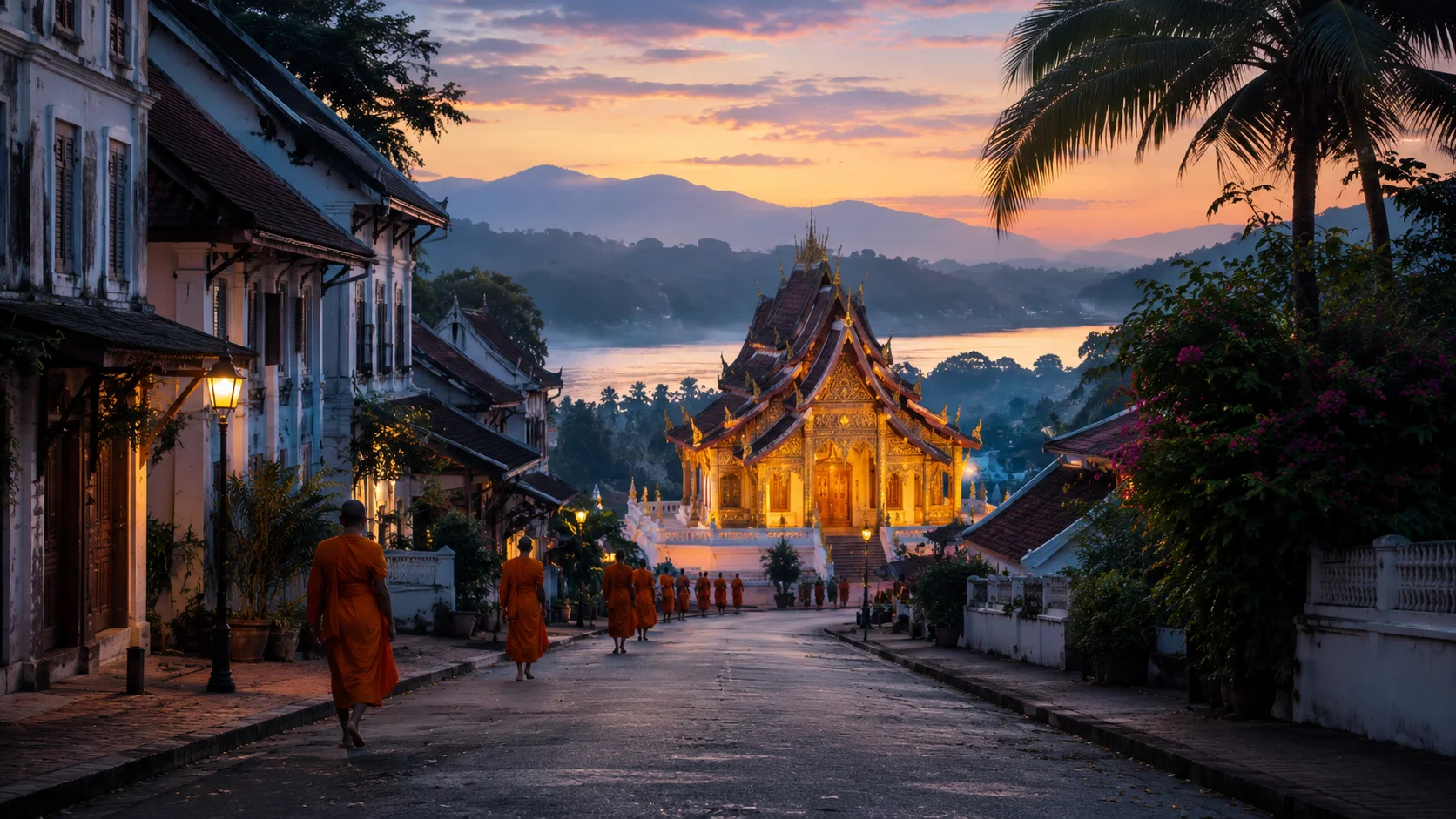
Just before 6am, before the mist has lifted off the Mekong, the streets of Luang Prabang fill with a quiet procession — lines of saffron-and-maroon-robed monks walking barefoot past kneeling residents who spoon sticky rice into their alms bowls, the whole scene lit only by streetlamps and the first grey edge of daylight. No one speaks much above a whisper. It’s one of the few living Buddhist rituals in Southeast Asia that hasn’t been fully reshaped around tourism, though the growing rows of tour buses parked nearby suggest that balance is fragile. Luang Prabang, a former royal capital tucked into the mountains of northern Laos, was named a UNESCO World Heritage Site for the way French colonial architecture and Buddhist temple culture sit layered on top of each other along its narrow peninsula streets. Most visitors give it two nights on a longer Laos or Southeast Asia loop; the town holds enough texture to justify twice that.
Temples and Luang Prabang’s Landmark Sites
Luang Prabang’s UNESCO-protected old town holds one of the highest concentrations of active Buddhist temples in the region, most still functioning as working monasteries rather than museum pieces.
- Wat Xieng Thong — The town’s most significant temple, built in 1560, distinguished by a sweeping roofline that nearly touches the ground and an elaborate mosaic “tree of life” on its rear exterior wall.
- Mount Phousi — A steep, 100-meter hill in the center of town, climbed via several hundred steps to a small gilded stupa and a sunset view over the Mekong and surrounding mountains.
- Royal Palace Museum (Haw Kham) — The former residence of the Lao royal family, preserved largely as it was before the monarchy was dissolved in 1975, including the throne room and royal ceremonial artifacts.
- Wat Mai Suwannaphumaham — A temple known for its five-tiered roof and gilded relief work depicting scenes from the life of Buddha, located directly beside the Royal Palace Museum.
- Tak Bat (morning alms-giving ceremony) — A daily ritual, not a fixed site, where monks from the town’s temples walk in procession before dawn to receive food offerings from kneeling residents and respectful visitors.
Two full days covers the main temples and the alms-giving ceremony without feeling rushed; a single combined ticket covers entry to several of the town’s most significant temples and the Royal Palace Museum.
Beyond the Temples: A Town Finding Its Own Voice
The night market that fills Sisavangvong Road each evening is the town’s commercial and social center, with stalls selling handwoven textiles, silver jewelry, and a food section serving Lao specialties at prices well below the riverside restaurants nearby.
For a quieter, evolving side of town, the streets around Kingkitsarath Road and the area near Utopia have developed a small concentration of independent cafes, boutiques selling naturally dyed textiles, and design studios run by younger Lao entrepreneurs, distinct from the more tourist-facing shops closer to the Royal Palace.
For a cultural experience beyond the temples, the Traditional Arts and Ethnology Centre (TAEC) offers a well-curated look at the textile and craft traditions of Laos’s diverse ethnic groups, a useful counterpoint to the town’s Buddhist and French colonial history for understanding the wider region.
Where to Eat in Luang Prabang
Lao cuisine is distinct from its Thai and Vietnamese neighbors, built around sticky rice, fresh herbs, and a fermented fish sauce base that gives many dishes a distinctly funky depth.
Dishes to look for:
- Laap (larb) — a minced meat or fish salad tossed with toasted rice powder, herbs, lime, and chili, considered something close to a national dish.
- Or lam — a rustic stew of buffalo meat or other proteins with eggplant, mushrooms, and a bitter local wood called sakhan, a Luang Prabang specialty rarely found further south in Laos.
- Khao soi (Luang Prabang style) — a tomato-based minced pork noodle soup distinct from the coconut curry noodle dish of the same name found in northern Thailand.
- Sticky rice (khao niaw) — the staple starch of the region, eaten by hand and served in a woven bamboo basket alongside nearly every meal.
Fine dining: Manda de Laos occupies a restored former royal fishpond setting and serves an elevated, plated take on traditional Lao dishes. L’Elephant offers French-Lao fusion in a colonial-era building, popular for special-occasion dinners.
Mid-range and social-enterprise spots: Tamarind runs both a restaurant and a well-regarded cooking school focused on introducing visitors to Lao ingredients and techniques. Big Brother Mouse, while primarily a literacy nonprofit, connects visitors with community-based dining and reading events that support local education.
Street food and markets: The food section of the night market on Sisavangvong Road is the most reliable spot for laap, grilled river fish, and sticky rice at local prices. The morning market near the old town offers a more local, less tourist-oriented look at Lao produce and ingredients.
Coffee and cafes: Saffron Coffee sources directly from small-scale Lao coffee farmers and has become the town’s most recognized specialty coffee brand. Le Banneton is a longstanding French-style bakery and cafe popular for breakfast and pastries.
Where to Stay in Luang Prabang
Luxury: Amantaka, set in a former French colonial hospital building, is the benchmark luxury property in town, with a large pool and spa built around the original colonial architecture. Rosewood Luang Prabang occupies a valley setting on the town’s edge, with tented and pool villas built into the hillside.
Boutique and mid-range: Villa Maly and The Apsara both offer well-reviewed boutique rooms in restored colonial-era buildings within walking distance of the old town’s temples and night market.
Budget: Numerous family-run guesthouses line the streets just outside the old town’s core, offering simple rooms at low prices, often with a small breakfast included and an easy walk into the town center.
Where to base yourself: Staying within the old town peninsula, between the Royal Palace and Wat Xieng Thong, puts you within walking distance of nearly everything, including the pre-dawn alms-giving ceremony — a meaningful advantage given how early it begins.
What to Do Beyond the Temples
- Kuang Si Falls day trip — A multi-tiered turquoise waterfall about 30 minutes outside town, with several swimmable pools and a bear rescue sanctuary near the entrance.
- Pak Ou Caves boat trip — A slow boat ride up the Mekong to a pair of limestone caves filled with thousands of small Buddha statues left by generations of pilgrims.
- Lao cooking class — Schools like Tamarind teach laap, or lam, and other regional dishes, often starting with a local market tour.
- Living Land Farm rice-farming experience — A working organic farm outside town where visitors can try each stage of traditional rice cultivation, from plowing with water buffalo to threshing.
- Traditional Lao textile weaving class — Workshops around town, including some connected to TAEC, teach traditional backstrap loom weaving techniques still practiced in nearby villages.
- Mekong sunset cruise — A slower, quieter way to see the river and surrounding mountains than a daytime boat trip, often paired with a stop at a riverside village.
- Ock Pop Tok Living Crafts Centre — A textile studio and cultural center along the Mekong offering weaving and natural dye workshops alongside a small museum of traditional Lao textiles.
- Whisky village (Ban Xang Hai) — A small riverside village known for producing lao-lao rice whisky, a common stop combined with the Pak Ou Caves boat trip.
When to Go: Luang Prabang Travel Guide Seasons
- November to February — The cool, dry season and generally the most comfortable time to visit, with the clearest mornings for the alms-giving ceremony and Mount Phousi sunset views, though also the busiest and priciest window.
- March to May — Hot season, with temperatures climbing significantly and a period of agricultural burning in the surrounding region that can create noticeable haze — worth checking conditions before booking this window.
- June to October — The wet season, with the Mekong running high and the surrounding hills at their greenest, though heavy rain can occasionally disrupt day trips to Kuang Si Falls or the Pak Ou Caves.
Practical Notes for the Trip
- Getting there: Luang Prabang International Airport has direct connections to Vientiane, Bangkok, Hanoi, and a handful of other regional hubs; overland travel from Vientiane by bus or the newer high-speed rail line is also an option.
- Getting around: The old town is entirely walkable; tuk-tuks and bicycle rental cover trips slightly further out, while day trips to Kuang Si Falls or the Pak Ou Caves typically require a hired driver or boat.
- Visas: Most nationalities can obtain a Lao visa on arrival at the airport or apply for an e-visa in advance; requirements change periodically, so check current rules before booking.
- Dress code and etiquette: Modest dress is required at temples; for the alms-giving ceremony, visitors should stay silent, keep a respectful distance, avoid flash photography, and refrain from participating unless properly prepared with appropriate food and understanding of the ritual.
- Currency: Lao kip is standard for local purchases; Thai baht and US dollars are also widely accepted for larger transactions like hotels and tours.
A Final Thought
Luang Prabang holds its rituals carefully, even as tourism reshapes the streets around them. The morning alms procession still happens exactly as it has for centuries, whether or not a bus of visitors is there to watch it, and that quiet persistence is what stays with people longer than any single temple or waterfall. Come with two days blocked off for the obvious sights, but leave room for an early morning with nowhere particular to be — that’s usually when the town shows its real self.