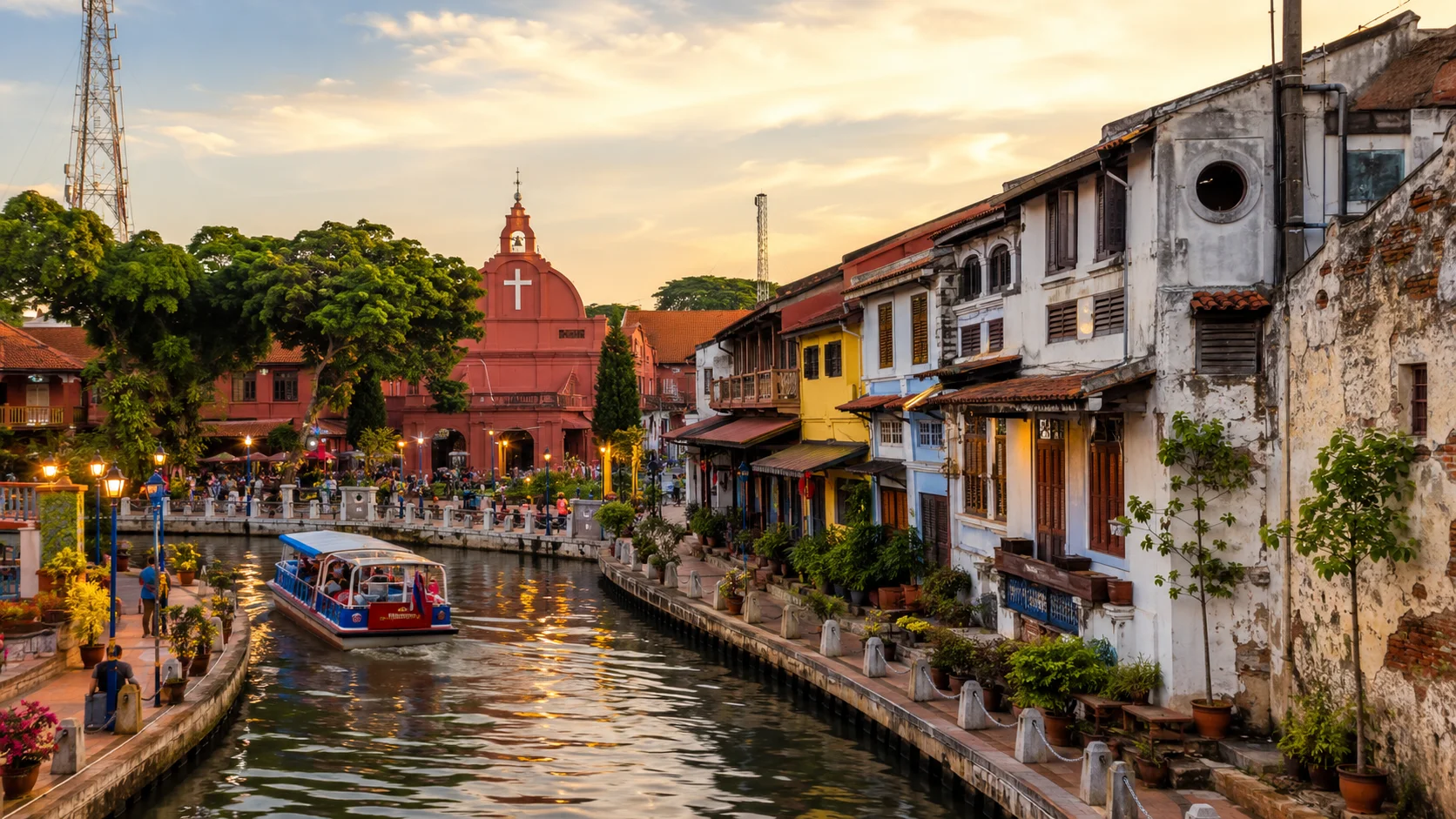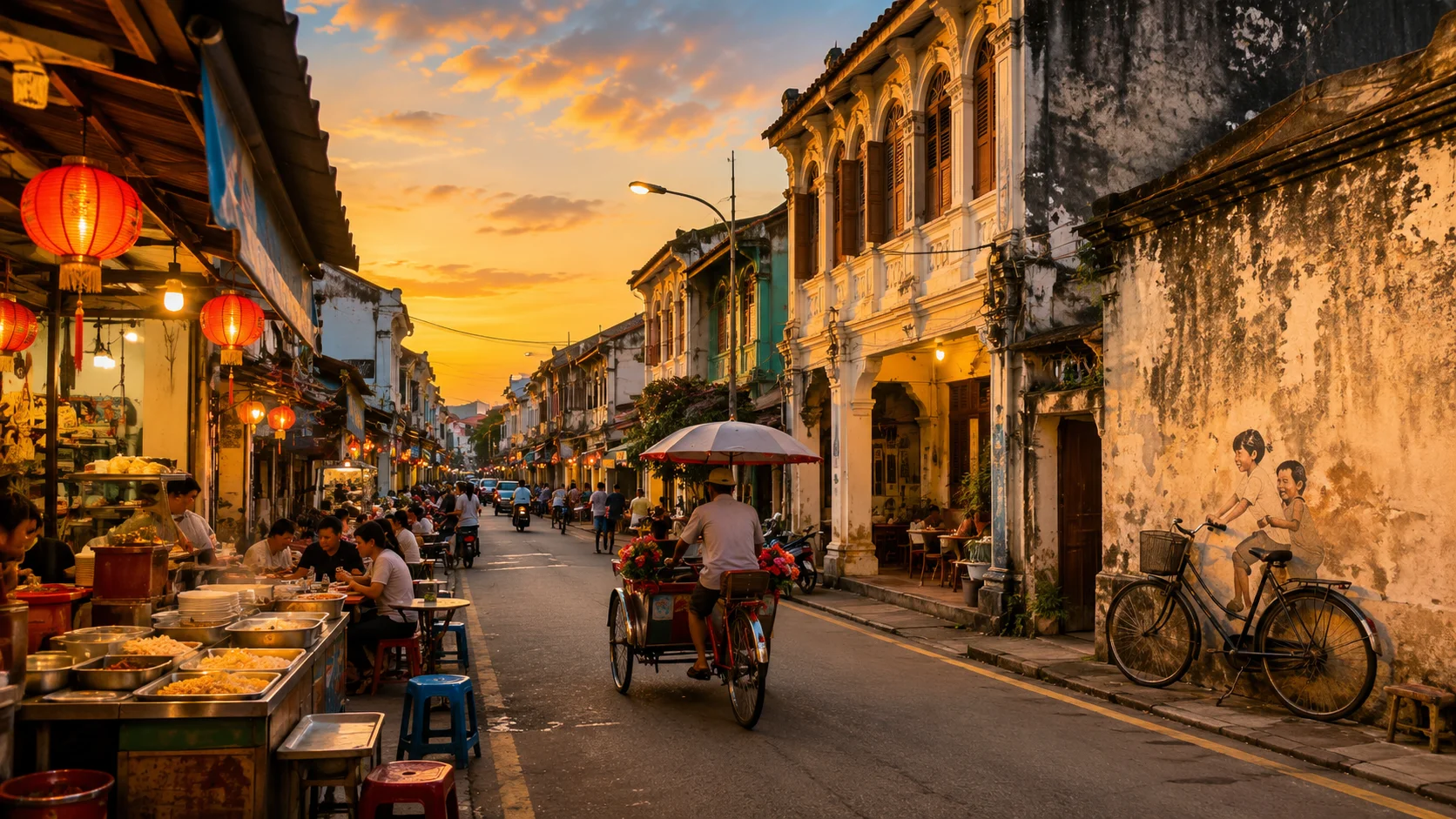
There’s a particular quiet to the Malacca River just after sunset, when the trishaws lining Jonker Street switch on strings of LED lights and pump out mismatched pop music, while a few steps away the red laterite walls of a 17th-century Dutch church glow under floodlights across the square. Walk a few blocks further and a mosque with Sumatran-style tiered roofing sits close enough to a centuries-old Chinese temple that the incense from one drifts into the courtyard of the other. Malacca changed hands between Malay sultans, Portuguese, Dutch, and British colonizers over five hundred years, and unlike cities that erase one layer to build the next, it kept nearly all of them visible at once. Most visitors give it a single day trip from Kuala Lumpur; the town’s UNESCO-listed core holds enough historical density to justify an overnight stay or two.
Old Town and Malacca’s Landmark Sites
Malacca’s UNESCO World Heritage core packs Portuguese, Dutch, British, and Peranakan history into a compact, walkable district straddling the Malacca River.
- A Famosa and St. Paul’s Hill — The remaining gate of a Portuguese fortress built in 1511, with the ruins of a hilltop church above it offering a view over the town and strait, though little of the original fortress survives beyond this single structure.
- Stadthuys and Dutch Square — A cluster of deep red-painted Dutch colonial administrative buildings from the 1650s, now housing a history museum, marking the most photographed square in the old town.
- Jonker Street (Jalan Hang Jebat) — The heart of Malacca’s Chinatown, lined with antique shops, Peranakan clan houses, and a night market that transforms the street on weekend evenings.
- Cheng Hoon Teng Temple — Malaysia‘s oldest functioning Chinese temple, built in the 1600s, dedicated to the goddess of mercy and still an active place of worship rather than a museum piece.
- Malacca River cruise — A boat trip along the river at dusk, passing murals, old warehouses, and riverside cafes lit for the evening, offering a different vantage point on the old town than walking its streets.
A day and a half to two days is enough to see the core historical sites without rushing; the old town is small enough to cover on foot, with most major sights within a 15-20 minute walk of each other.
Beyond the Old Town: A Town Finding Its Own Voice
The Jonker Street weekend night market remains the town’s commercial and social anchor, though a walk through its side streets on a quieter weekday morning reveals a different, more workaday version of the same neighborhood — tailors, herbalists, and family-run shops that predate the tourist crowds by generations.
For the town’s evolving identity, the streets around Jalan Tun Tan Cheng Lock and pockets of the Heeren Street area have seen a wave of boutique cafes and small design shops open inside restored Peranakan shophouses, distinct from the souvenir-heavy stretch of Jonker Street itself.
For a cultural experience with real depth, the Baba Nyonya Heritage Museum, set inside an actual former Peranakan family residence, offers a far more intimate look at Straits Chinese domestic life and customs than a standard museum display, with furniture and artifacts still arranged largely as the family left them.
Where to Eat in Malacca
Malacca’s food culture is often credited as the birthplace of Peranakan (Nyonya) cuisine, the result of generations of intermarriage between Chinese immigrants and the local Malay population.
Dishes to look for:
- Nyonya laksa — a coconut milk-based noodle soup distinct from Penang’s tamarind-based assam laksa, considered one of the defining dishes of Peranakan cuisine.
- Chicken rice balls — a Malacca-specific twist on Hainanese chicken rice, where the rice is hand-rolled into golf ball-sized portions rather than served loose.
- Satay celup — skewers of meat, seafood, and vegetables cooked tableside in a shared pot of peanut sauce, a Malacca variation on hot pot dining.
- Cendol — a shaved ice dessert with green rice flour jelly, coconut milk, and palm sugar syrup, with Malacca’s Jonker Street version frequently cited among the country’s best.
Fine dining: Nancy’s Kitchen has built a strong reputation for refined, home-style Peranakan cooking served in a proper sit-down setting. Amy Heritage Nyonya Cuisine offers a similarly elevated take on traditional family recipes.
Mid-range and social-enterprise spots: Capitol Satay is a long-running local institution for satay celup, often with a wait during peak dinner hours. Several restored shophouse cafes around Heeren Street support small local producers alongside their food and coffee offerings.
Street food and markets: The Jonker Street night market on weekend evenings is the most concentrated spot for cendol, chicken rice balls, and other Malacca specialties at local prices. The Jonker 88 food court area offers a more casual, air-conditioned alternative for sampling a range of dishes in one stop.
Coffee and cafes: Calanthe Art Cafe on Jonker Street focuses on Malaysian single-origin coffee served alongside traditional white coffee. Several boutique cafes around Heeren Street cater to a slower, more design-conscious crowd than the main tourist strip.
Where to Stay in Malacca
Luxury: The Majestic Malacca occupies a restored 1920s mansion, blending colonial-era architecture with a full-service spa and pool. Casa del Rio Melaka offers a riverside setting with a Dutch colonial-inspired design just steps from Dutch Square.
Boutique and mid-range: Hotel Puri, converted from a 19th-century Peranakan townhouse, and Heeren House both offer distinctive stays in restored heritage buildings within walking distance of the old town’s main sights.
Budget: Numerous hostels and guesthouses cluster around Jonker Street and the surrounding old town streets, offering dorms and simple private rooms close to the main sights and night market.
Where to base yourself: Staying within the UNESCO core, on or near Jonker Street and Heeren Street, puts you within walking distance of nearly everything, including the river cruise departure points and the weekend night market.
What to Do Beyond the Old Town
- Malacca River cruise at dusk — A boat trip passing riverside murals, old warehouses, and cafes, offering a quieter perspective on the town than its crowded streets.
- Peranakan cooking class — Several schools around the old town teach nyonya laksa, chicken rice balls, and other Peranakan dishes, often paired with a market visit.
- Baba Nyonya Heritage Museum tour — A guided visit through an intact former Peranakan family home, offering insight into Straits Chinese customs and design.
- Portuguese Settlement visit — A small community descended from Malacca’s Portuguese colonial era, with its own dialect and seafood-focused food stalls, a short drive from the old town.
- Bukit China (Chinese Hill) — One of the largest Chinese cemeteries outside China, with graves dating back centuries, offering a quieter historical counterpoint to the busier old town streets.
- Straits Quay or Melaka Straits Mosque visit — A mosque built partly on stilts over the water, with a design blending Middle Eastern and local architectural influences, a short drive from the old town.
- Antique hunting on Jonker Street — Beyond the night market crowds, daytime visits to the street’s antique shops offer a slower look at Peranakan furniture, ceramics, and jewelry.
- Ayer Keroh recreational forest — A green space on the town’s outskirts offering a break from the old town’s density, with a zoo and botanical gardens.
When to Go: Malacca Travel Guide Seasons
- December to February — Generally the driest stretch of the year, with lower humidity and comfortable conditions for walking the old town.
- March to June and September to November — Intermonsoon periods with a mix of sun and short afternoon downpours, usually manageable if plans stay flexible.
- October to November — The wetter end of the year under the northeast monsoon, with a higher chance of sustained rain, though Malacca is somewhat sheltered compared to Malaysia’s east coast.
Practical Notes for the Trip
- Getting there: Most visitors arrive via a roughly two-hour bus or car journey from Kuala Lumpur; Malacca’s own airport has limited domestic connections, making road transport from KL the more practical option for most travelers.
- Getting around: The old town is walkable for nearly all major sights; trishaws offer a novelty way to cover short distances, and Grab covers trips slightly further out like Ayer Keroh or the Portuguese Settlement.
- Visas: Many nationalities can enter Malaysia visa-free for tourism up to a set number of days; requirements vary by nationality and change periodically, so check current rules before booking.
- Dress code and etiquette: Modest dress is expected at mosques and temples, including covered shoulders and knees; shoes are removed before entering religious sites and some heritage homes.
- Currency: Malaysian ringgit is standard; cards are accepted at hotels and larger restaurants, while cash remains preferred at night market stalls and smaller shops.
A Final Thought
Malacca doesn’t ask visitors to imagine its history the way a ruin or a plaque might elsewhere — the layers are simply still standing, a Portuguese gate a short walk from a Dutch church a short walk from a working Chinese temple, each still doing roughly what it was built to do centuries ago. Spend an evening on the river after the day-trip crowds from Kuala Lumpur have cleared out, and the town settles into something quieter and more legible: not a single historical moment preserved in amber, but five centuries that never fully finished overlapping.