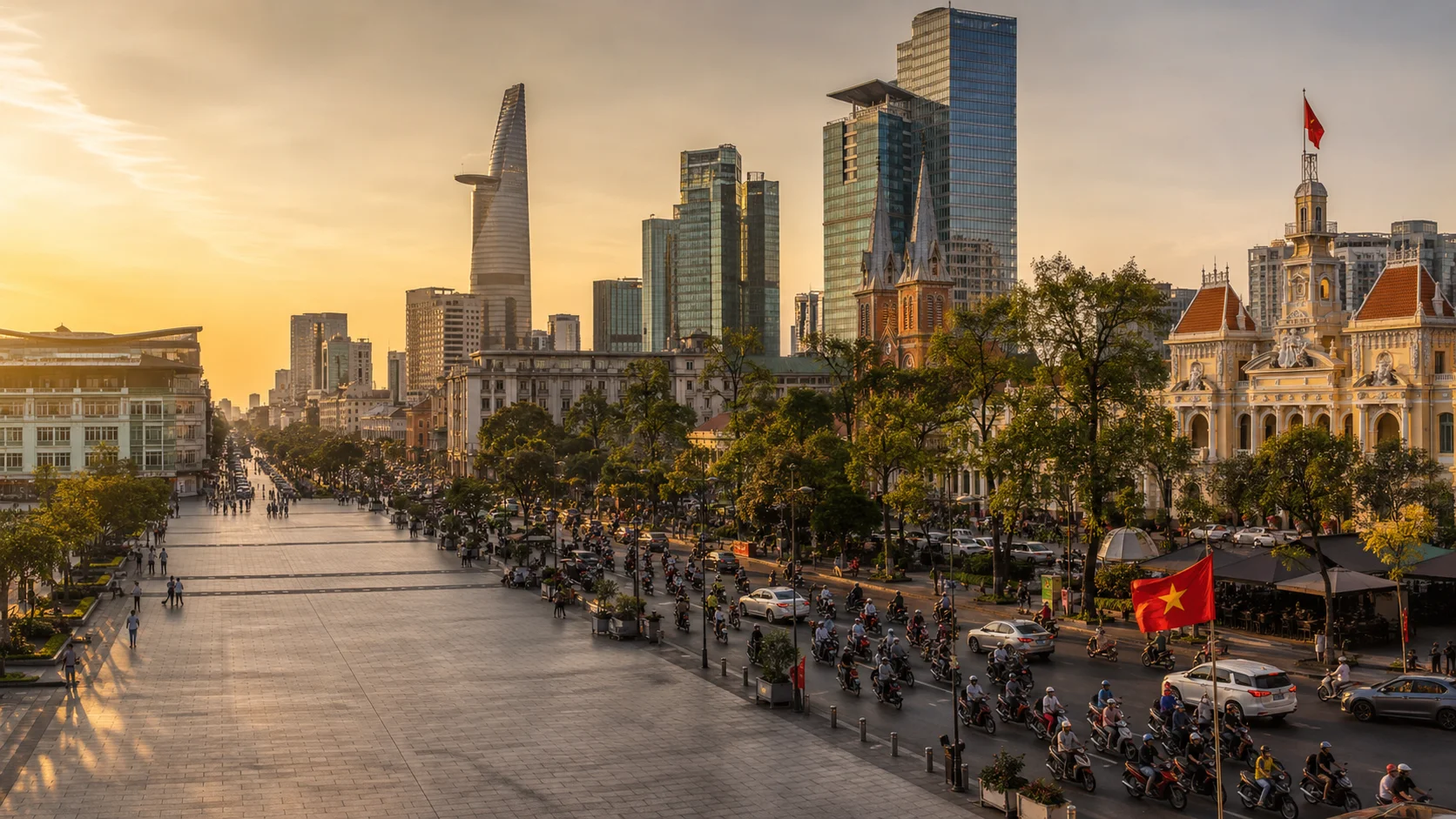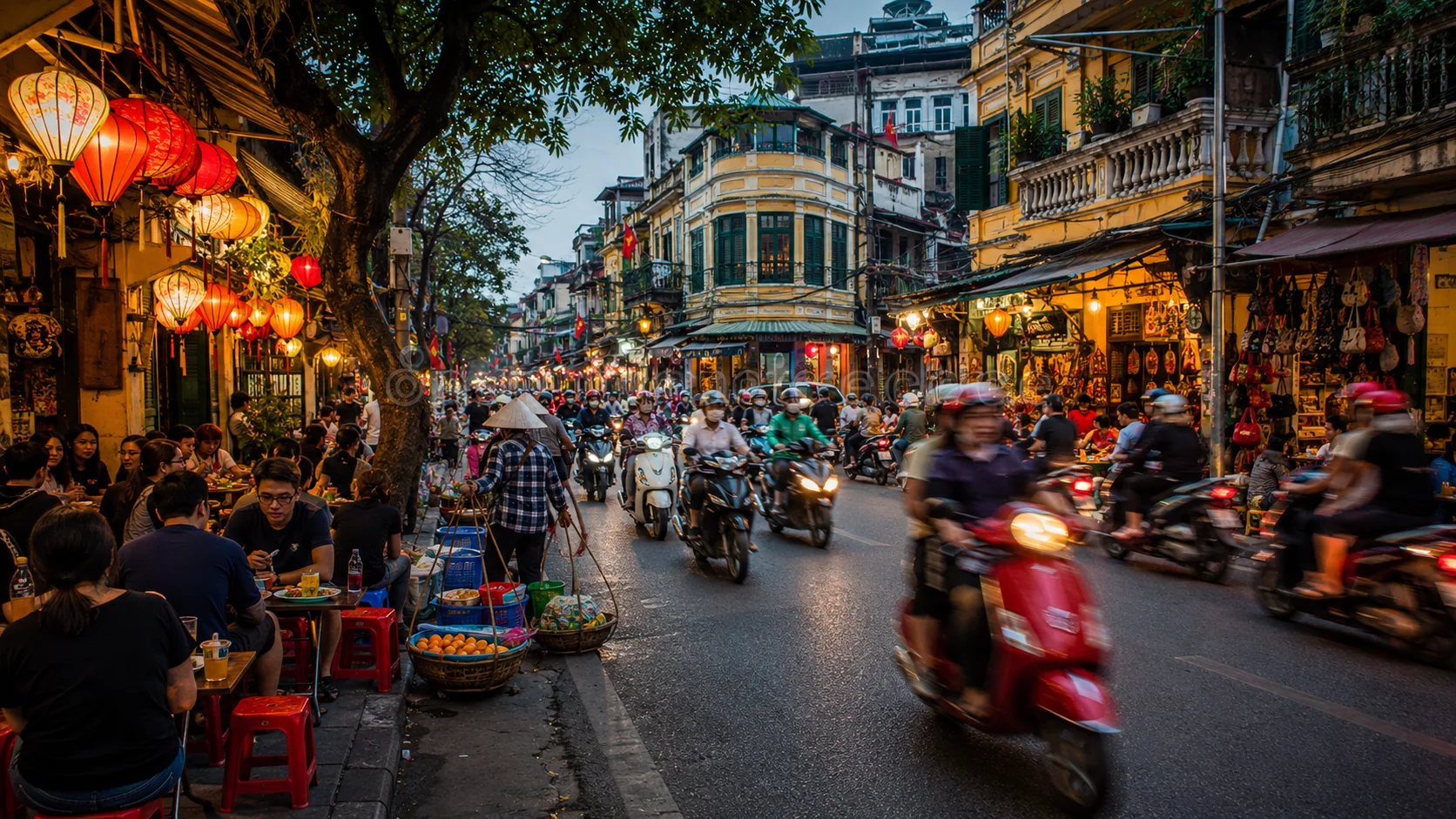
There’s a particular chaos to a Saigon intersection at rush hour — thousands of motorbikes flowing through in a pattern that looks lawless until you notice its logic, weaving around a woman balancing two baskets of dragon fruit on a shoulder pole, past a street vendor flipping banh xeo on a portable gas burner, horns used not in anger but as a constant, low-level conversation between drivers. Locals still call it Saigon more often than Ho Chi Minh City, a small linguistic holdout in a place that has always run a step ahead of official designations. This is Vietnam’s largest city and its economic engine, and it wears that energy openly — less reverent than Hanoi, less precious than Hoi An, and more interesting for it. Most travelers give it a day or two before heading to the Mekong Delta or the coast; the city has enough depth to hold attention far longer.
District 1 and Saigon’s Landmark Sites
Saigon’s most visited sites cluster in District 1, tracing the city’s layered history from French colonial capital to wartime flashpoint to modern metropolis.
- Notre-Dame Cathedral Basilica — A red-brick French colonial cathedral built with materials imported from France in the 1880s, currently under long-term restoration, though still viewable from the surrounding square.
- War Remnants Museum — A sobering, unflinching account of the Vietnam War from the Vietnamese perspective, including preserved military hardware in the courtyard and photography exhibits that don’t soften the war’s civilian toll.
- Reunification Palace — The former South Vietnamese presidential palace, preserved largely as it was on the day Saigon fell in 1975, including the underground war command bunkers.
- Ben Thanh Market — A covered market that has operated in some form since the early 1900s, now a dense mix of souvenirs, fabric, and food stalls, best visited early before the tour buses arrive.
- Jade Emperor Pagoda — A Taoist temple thick with incense smoke, packed with elaborately carved wooden statues depicting scenes from Chinese and Vietnamese mythology, one of the more atmospheric religious sites in the city.
Two to three days covers the core District 1 sites comfortably, with the War Remnants Museum and Reunification Palace best paired on the same day given their shared historical thread.
Beyond District 1: A City Finding Its Own Voice
Cho Lon, Saigon’s historic Chinatown centered around Binh Tay Market, operates at a different rhythm than the tourist-heavy District 1 core — wholesale traders, traditional medicine shops, and Chinese-Vietnamese temples give it a texture closer to the city’s actual working life than the postcard sites nearby.
For the city’s newer identity, District 3 and pockets of Thao Dien in District 2 have become the center of Saigon’s design and cafe culture, with converted villas housing independent boutiques, art spaces, and a wave of Vietnamese-owned coffee roasters distinct from the international chains that dominate District 1’s main streets.
For a cultural experience with real weight, the Municipal Theatre (Saigon Opera House) hosts the A O Show, a contemporary Vietnamese performance blending acrobatics, live bamboo-based music, and choreography inspired by rural village life — a striking counterpoint to the war-focused history most visitors encounter elsewhere in the city.
Where to Eat in Saigon
Saigon’s food scene reflects its history as a trading and immigration hub, blending southern Vietnamese, Chinese, and French influences more freely than anywhere else in the country.
Dishes to look for:
- Banh mi — Saigon’s version tends toward a wider range of fillings and condiments than elsewhere in Vietnam, a legacy of the city’s French colonial bakeries adapted with local ingredients.
- Com tam (broken rice) — grilled pork chop, a fried egg, and pickled vegetables served over rice made from broken grains, originally a working-class dish now found everywhere from street carts to sit-down restaurants.
- Banh xeo — a crispy, turmeric-yellow rice flour crepe filled with shrimp, pork, and bean sprouts, folded and eaten wrapped in lettuce and herbs.
- Hu tieu — a noodle soup with Chinese-Cambodian roots, served either in broth or dry with a side soup, reflecting Saigon’s mixed immigrant food history.
Fine dining: Anan Saigon, run by chef Peter Cuong Franklin, reworks Vietnamese street food classics into a tasting-menu format in a converted Ben Thanh Market building. Nen Light Box in Da Nang’s sister project has a Saigon presence known for elevated, ingredient-driven Vietnamese tasting menus.
Mid-range and social-enterprise spots: KOTO Saigon and similar programs train disadvantaged youth in hospitality while serving a solid Vietnamese-international menu. Cuc Gach Quan is known for home-style Vietnamese cooking served in a restored old villa filled with antique furniture.
Street food and markets: Ben Thanh Market’s food stalls are a reliable, if touristy, starting point; for a more local experience, the street food alley around Ho Thi Ky Market operates late into the night and draws more locals than tourists.
Coffee and cafes: The Workshop Coffee, tucked up a narrow staircase in a converted District 1 building, is a longstanding favorite for specialty coffee in a bright, industrial space. Cafe Suoi Da and other Vietnamese-owned roasters around District 3 offer a more local alternative to the international chains, alongside the classic ca phe sua da (iced milk coffee) sold from sidewalk stools across the city.
Where to Stay in Saigon
Luxury: The Reverie Saigon leans into maximalist, opulent design across its rooms and public spaces, popular for its rooftop bar views over the city skyline. Park Hyatt Saigon sits directly on the Notre-Dame Cathedral square, blending French colonial and contemporary Vietnamese design in one of the city’s most central locations.
Boutique and mid-range: Villa Song Saigon, set along the Saigon River in Thao Dien, offers a quieter riverside base away from the District 1 crowds. Silverland Sakyo Hotel and similar mid-range properties in District 1 and District 3 offer solid comfort within walking distance of the main sites.
Budget: The Bui Vien backpacker strip in District 1 has the highest concentration of hostels and budget guesthouses, alongside the city’s most concentrated nightlife scene. Quieter, similarly priced guesthouses can be found a few streets back from Bui Vien for travelers who want budget prices without the noise.
Where to base yourself: District 1 puts you closest to the major historical sites and Ben Thanh Market, while Thao Dien in District 2 suits travelers who want a calmer, more residential base with strong cafes and restaurants, at the cost of a longer commute into the historic core.
What to Do in Saigon
- Cu Chi Tunnels day trip — An extensive underground tunnel network used by Viet Cong fighters during the war, about 90 minutes outside the city, with sections widened for visitors to crawl through.
- Mekong Delta day or overnight trip — River life, floating markets, and fruit orchards a few hours south of the city, typically visited via My Tho or Ben Tre as a starting point.
- Vietnamese cooking class — Several schools around the city teach banh xeo, com tam, and other Saigon staples, often paired with a market visit beforehand.
- Rooftop bar circuit — Saigon’s skyline has grown rapidly, and a run of rooftop bars in District 1 now offer views across the Saigon River and the older French colonial core in the same evening.
- Bitexco Financial Tower Skydeck — An observation deck offering a wide view over District 1 and the winding Saigon River, useful for orientation early in a visit.
- Traditional water puppet or A O Show performance — Live cultural performances that give a different lens on Vietnamese history and rural life than the city’s war-focused museums.
- Cyclo or motorbike food tour — A guided ride through the city’s back streets and food alleys, often covering neighborhoods and dishes difficult to find independently.
- Thao Dien art and design walk — A self-guided wander through District 2’s converted villas, galleries, and independent design studios, a useful counterpoint to the war-history-heavy District 1 sites.
When to Go
- December to April — The dry season and generally the most comfortable window for walking the city, with the added bonus of Tet (Lunar New Year) celebrations in late January or February, though the city partially shuts down for several days around the holiday itself.
- May to October — The wet season, with short, heavy afternoon downpours rather than all-day rain; humidity climbs, but the rain rarely lasts long enough to derail a full day of plans.
- November — A shoulder-season sweet spot, with the wet season tapering off and the dry season’s crowds not yet arrived.
Practical Notes for the Trip
- Getting there: Tan Son Nhat International Airport, just a few kilometers from District 1, is Vietnam’s busiest airport with extensive regional and long-haul connections.
- Getting around: Grab (ride-hailing) is the easiest way to navigate the city’s traffic and heat; the city’s first metro line has begun operating limited routes, gradually easing pressure on road traffic.
- Visas: Standard Vietnamese e-visa or visa-exemption rules apply, the same as elsewhere in the country; check current requirements before booking.
- Dress code and etiquette: Modest dress is expected at temples and pagodas; the Reunification Palace and War Remnants Museum are best approached with a respectful, unhurried pace given their historical weight.
- Currency: Vietnamese dong is standard for everyday purchases; cards are widely accepted in District 1 restaurants and hotels, though cash remains dominant for street food and markets.
A Final Thought
Saigon doesn’t ask to be admired the way Hoi An’s lantern-lit streets do, or approached with the same solemnity as Hanoi’s mausoleum. It’s a working city first, one that absorbed French colonizers, a brutal war, and decades of rapid economic change without losing its own momentum. Spend a few days moving between its war museums, its Chinatown markets, and its rooftop bars, and what comes through isn’t nostalgia — it’s a city that has always been too busy building its next chapter to spend much time looking back.