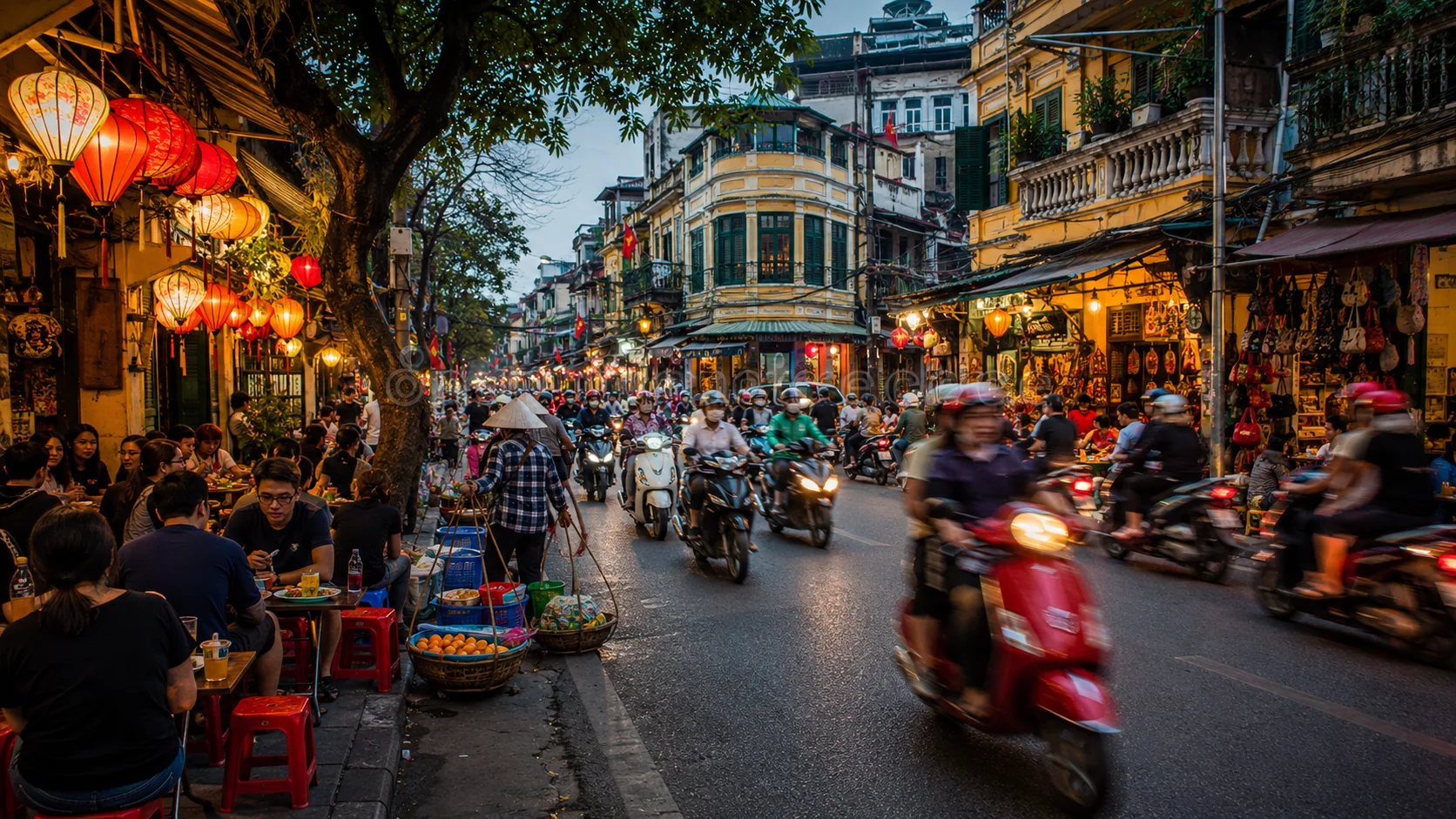
There’s a sound that defines Hanoi before you ever see it — the low, constant hum of thousands of motorbike engines threading through streets barely wide enough for two cars, punctuated by a vendor’s bicycle bell and the hiss of a wok from a sidewalk stall. Cross an Old Quarter street for the first time and you’ll understand why locals insist you simply walk, slow and steady, and let the traffic flow around you. That controlled chaos is Hanoi’s opening statement, but stay past the first day and the city softens into something else entirely: a place of French colonial villas gone soft with age, lakes wrapped in morning tai chi, and a culinary culture so precise that entire streets specialize in a single dish. Hanoi rewards travelers who resist the urge to treat it as a two-night stop before Ha Long Bay.
Old Quarter and Hanoi’s Landmark Sites
Hanoi’s core sights are dense and walkable, tracing a thousand years of history from imperial capital to French colony to modern capital.
- Hoan Kiem Lake and Ngoc Son Temple — The spiritual center of the city, where a red bridge leads to a small island temple, and locals gather at dawn for tai chi, badminton, and quiet laps around the water.
- Temple of Literature — Vietnam’s first national university, founded in 1070, with courtyards of stone stelae resting on turtle bases that record the names of doctoral graduates going back centuries.
- Hoa Lo Prison (Maison Centrale) — Built by the French to hold Vietnamese political prisoners and later used to hold American POWs, with exhibits that cover both chapters unflinchingly.
- Ho Chi Minh Mausoleum and Presidential Palace complex — A solemn, heavily guarded site where Ho Chi Minh’s embalmed body lies in state; strict rules on dress and behavior apply, and it closes for a few months each year for maintenance.
- St. Joseph’s Cathedral — A neo-Gothic church from the 1880s, its stone facade blackened with age, tucked into a small square that turns lively with cafes at night.
Two to three days is the right amount of time to cover these sites without rushing between them, and most are close enough together to link on foot through the Old Quarter.
Beyond the Old Quarter: A City Finding Its Own Voice
The Old Quarter itself rewards aimless wandering — its 36 streets are still loosely organized by the guild trades that once operated there, so you’ll pass a stretch selling only silk, then one selling only hardware, then one selling paper votive offerings for temple ceremonies.
For a different pace, head to the French Quarter around Ly Thai To Street, where tree-lined boulevards and colonial villas house design boutiques, art galleries, and some of the city’s most ambitious restaurants — a quieter, more deliberate contrast to the Old Quarter’s density. Tay Ho (West Lake), meanwhile, has become the neighborhood of choice for a younger, more international crowd, with lakeside cafes, craft breweries, and a growing expat community.
For an evening that captures something distinctly Hanoian, catch a performance at the Thang Long Water Puppet Theatre, where puppeteers standing waist-deep in water behind a screen perform folk tales accompanied by a live traditional orchestra — an art form unique to the Red River Delta region and still performed the way it has been for centuries.
Where to Eat
Hanoi is arguably Vietnam’s culinary capital, and its food culture is precise enough that many vendors have spent decades perfecting a single dish.
Dishes to look for:
- Pho — Hanoi’s version is typically lighter and clearer than the sweeter southern style, with a broth simmered for hours and served with beef or chicken.
- Bun cha — grilled pork patties and pork belly served in a bowl of sweet-savory dipping broth alongside cold rice noodles and herbs.
- Cha ca — turmeric-marinated fish, grilled tableside and folded into rice noodles with dill and peanuts, a dish so specific it has its own dedicated street.
- Banh cuon — steamed rice rolls filled with minced pork and mushroom, thin enough to be almost translucent, served with a light fish sauce dip.
- Egg coffee (ca phe trung) — a Hanoi invention: whipped egg yolk and condensed milk poured over strong Vietnamese coffee, more dessert than drink.
Fine dining: Tầm Vị serves refined home-style Vietnamese cooking in an intimate, reservation-only setting that regularly draws praise from visiting chefs. 1946 Restaurant leans into Hanoi’s colonial-era culinary history with a more formal dining room.
Mid-range and social-enterprise spots: KOTO trains disadvantaged and at-risk youth in hospitality while serving a solid Vietnamese-international menu near the Temple of Literature. Duong’s Restaurant is a reliable mid-range choice for well-executed Hanoi classics without the tourist markup.
Street food and markets: Bun Cha Huong Lien, made famous by a visit from Anthony Bourdain and Barack Obama, remains a legitimate destination in its own right, not just a novelty stop. The stretch of Cha Ca Street in the Old Quarter is where the dish essentially originated and is still where it’s done best.
Coffee and cafes: Cafe Giang, the original home of egg coffee, is still run by the founder’s family. The Note Coffee is known for its walls covered in visitor-written sticky notes, while Tranquil Books & Coffee near Hoan Kiem Lake offers a quieter reading-room atmosphere.
Where to Stay
Luxury: Sofitel Legend Metropole Hanoi is the city’s grande dame, a French colonial-era property that has hosted everyone from Charlie Chaplin to Graham Greene, with a preserved wartime bomb shelter beneath the pool. Apricot Hotel offers a more contemporary luxury experience overlooking Hoan Kiem Lake, with an extensive contemporary Vietnamese art collection throughout.
Boutique and mid-range: Hanoi La Siesta Hotel & Spa and its sister properties are well-reviewed for stylish rooms and attentive service at a mid-range price point in the heart of the Old Quarter. Splendid Star Grand Hotel is another dependable Old Quarter option with rooftop views.
Budget: Hanoi Backpackers Hostel has long been the social anchor of the city’s budget travel scene, with organized tours and a lively common area. Smaller family-run guesthouses throughout the Old Quarter offer simple rooms at low prices, often with breakfast included.
Where to base yourself: The Old Quarter puts you closest to the sights, food, and nightlife, though it’s noisy and can feel overwhelming; Tay Ho (West Lake) is a calmer, more residential alternative for travelers who want lake views and easy access to cafes, at the cost of a longer commute into the historic core.
What to Do
- Ha Long Bay day or overnight trip — Limestone karsts rising out of emerald water, typically visited via an overnight cruise from Hanoi (about 3-4 hours each way).
- Train Street — A narrow residential street where the railway track runs directly between houses, with cafes that pause service briefly as trains pass through.
- Vietnamese cooking class — Several schools around the Old Quarter teach pho, bun cha, and spring rolls, often starting with a market tour to select ingredients.
- Bat Trang pottery village — A traditional ceramics village about 30 minutes from the city center, where visitors can shape their own pieces on a wheel.
- Vietnam Museum of Ethnology — A well-curated look at the country’s 54 recognized ethnic groups, with full-scale traditional houses in the outdoor grounds.
- Cyclo tour of the Old Quarter — A slower, driver-led way to navigate the dense streets and see architecture easily missed on foot.
- West Lake sunset walk or bike ride — A loop around Hanoi’s largest lake, passing temples, cafes, and quiet residential lanes.
- Perfume Pagoda day trip — A boat and cable car (or hike) journey to a limestone cave temple complex about two hours outside the city, especially lively during the spring pilgrimage season.
When to Go
- October to December — Cool, dry, and generally considered the most comfortable season, with clear skies good for both city walking and Ha Long Bay visibility.
- January to March — Cooler and often overcast or drizzly, with a persistent low mist that can affect Ha Long Bay visibility, though temperatures stay mild.
- April to June — Warming up toward summer, generally dry with increasing humidity as the season progresses.
- July to September — Hot, humid, and the peak of typhoon season, with the heaviest rainfall and highest chance of weather disruptions to day trips.
Practical Notes for the Trip
- Getting there: Noi Bai International Airport connects to major regional hubs including Bangkok, Singapore, Seoul, and increasingly to long-haul destinations in Europe and Australia.
- Getting around: Grab (ride-hailing) is the easiest way to get around for visitors unfamiliar with the city; walking works well within the Old Quarter, though crossing streets takes some initial nerve.
- Visas: Many nationalities can apply for a Vietnamese e-visa online in advance; requirements and visa-exempt countries change periodically, so check current rules before booking.
- Dress code and etiquette: Modest dress is expected at the Ho Chi Minh Mausoleum and temples; loud behavior or photography is discouraged at the mausoleum specifically.
- Currency: Vietnamese dong is the only widely accepted currency for everyday purchases; carry cash for street food and smaller vendors, as card acceptance is inconsistent outside hotels and larger restaurants.
A Final Thought
Hanoi doesn’t try to make itself easy. The traffic keeps moving, the streets don’t run in straight lines, and the city rarely pauses to explain itself to a visitor. But that resistance to being packaged is exactly what makes it worth the extra days — a place where a thousand-year-old university sits blocks from a colonial-era cafe still serving the coffee it invented, and where the best meal of your trip is as likely to come from a plastic stool on the sidewalk as anywhere with a menu in English.